
Buyers didn't understand Knowde was a marketplace — or why they should create an account
Knowde is the world's largest marketplace for chemicals, ingredients, and polymers. Suppliers pay a subscription to list products; buyers browse for free. But user research revealed a core activation problem: anonymous buyers weren't converting.
Through user testing and data analysis, we identified three critical gaps that were stalling buyer engagement:
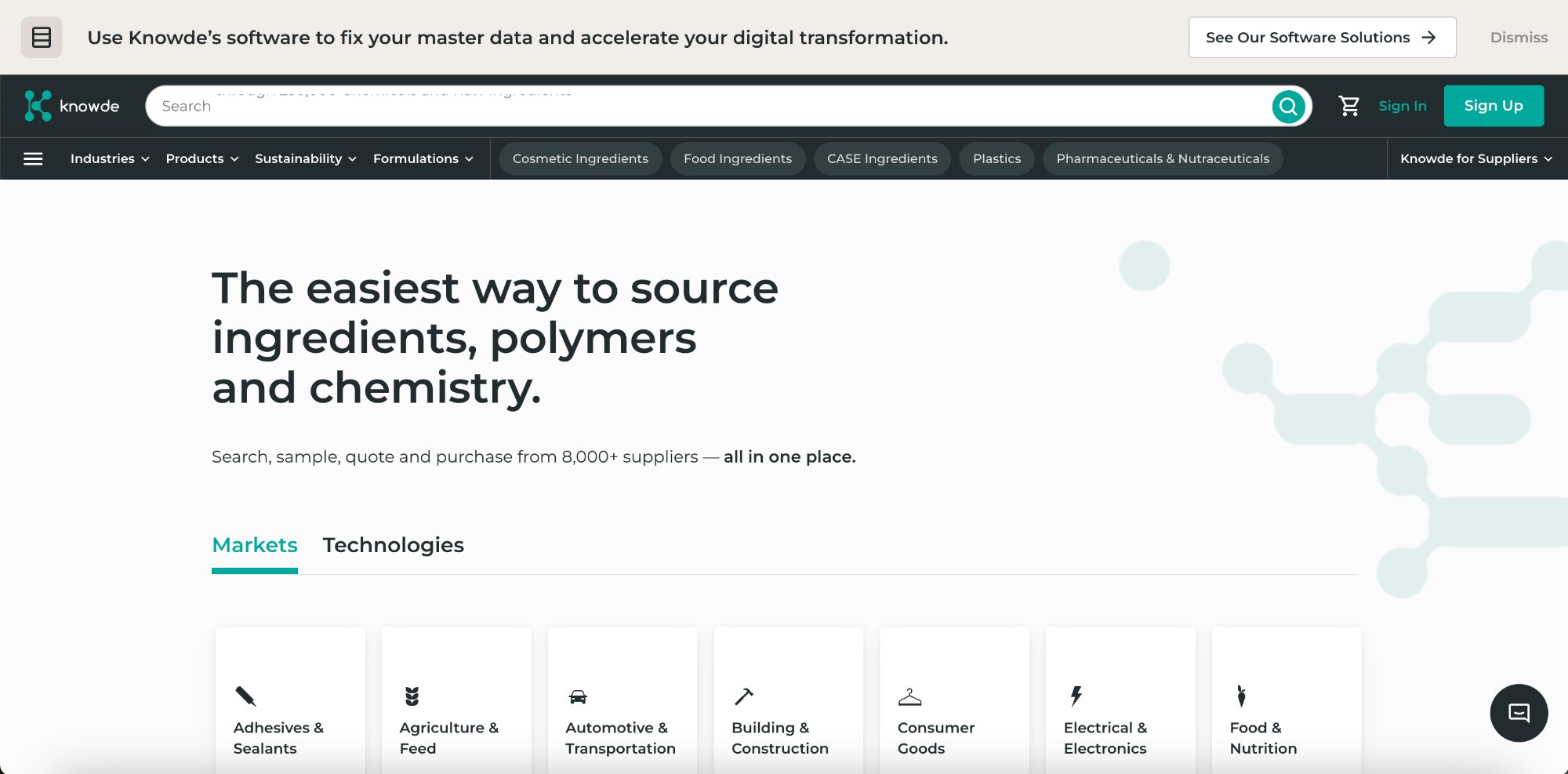
The Knowde homepage — buyers landed here but didn't understand it was a marketplace where they could transact.
Owning the buyer journey from first search to account activation
As Product Manager Intern, I owned several product surfaces that collectively shaped how buyers discovered, evaluated, and engaged with chemical products and suppliers on the platform. I managed a team of 2 backend and 4 frontend engineers across Q1/Q2 resource planning.
Features & initiatives I owned:
Ongoing processes I managed:
Homepage Redesign & Paywall A/B Testing
Buyers landed on Knowde's homepage and bounced — they didn't understand what the platform was, how to use it, or why they should sign up. The homepage needed to both orient new visitors and push them toward actions correlated with account activation (viewing products, performing searches).
The approach:
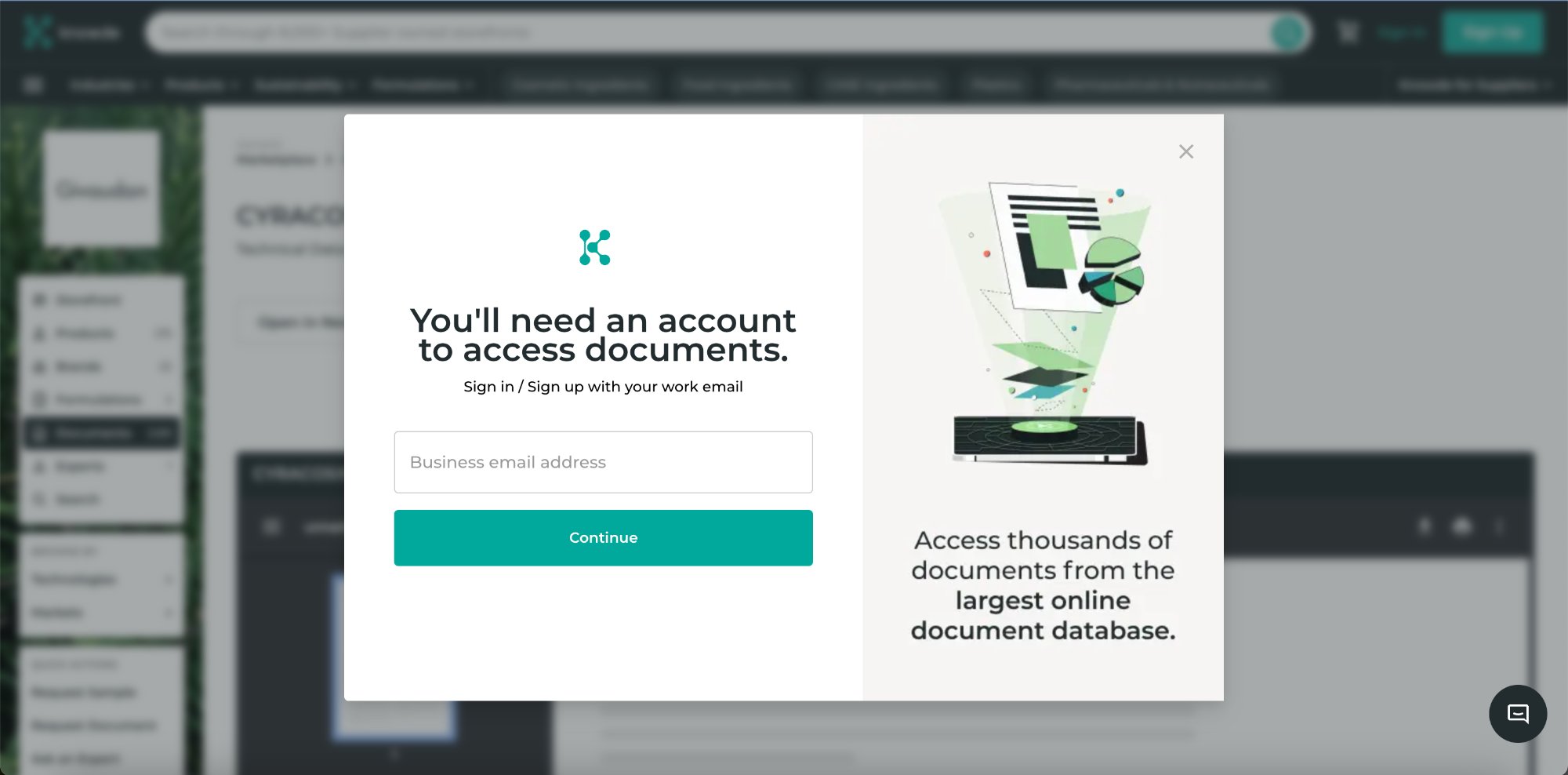
The paywall gate experience — we tested where in the journey to surface this sign-up prompt to maximize conversions without killing engagement.
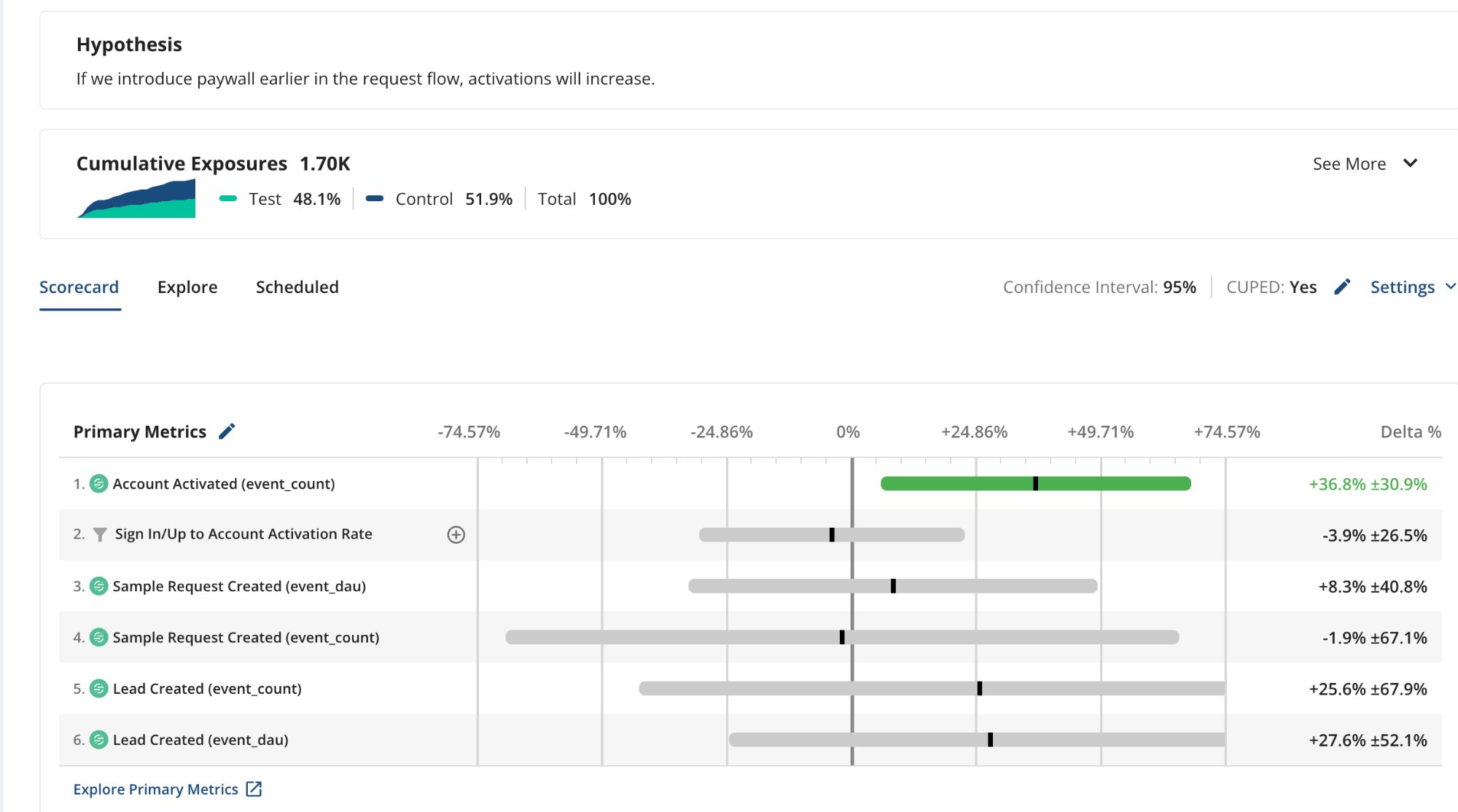
Statsig experiment scorecard (Variation 3, 1.7K exposures): +36.8% lift in Account Activated, with CUPED variance reduction applied at 95% CI.
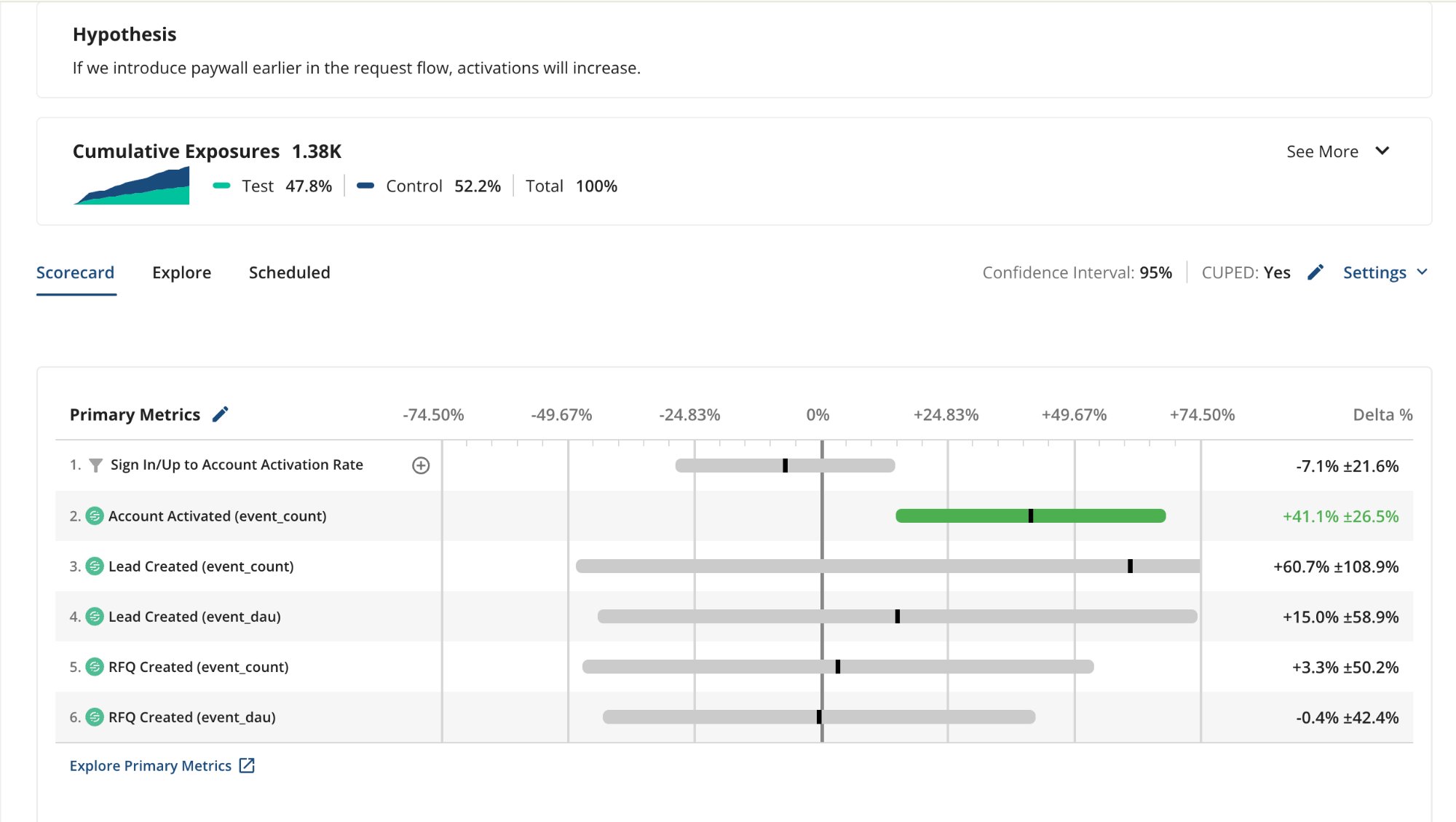
Variation 1 (1.38K exposures): +41.1% lift in Account Activated — strongest raw lift, though wider confidence interval at this sample size.
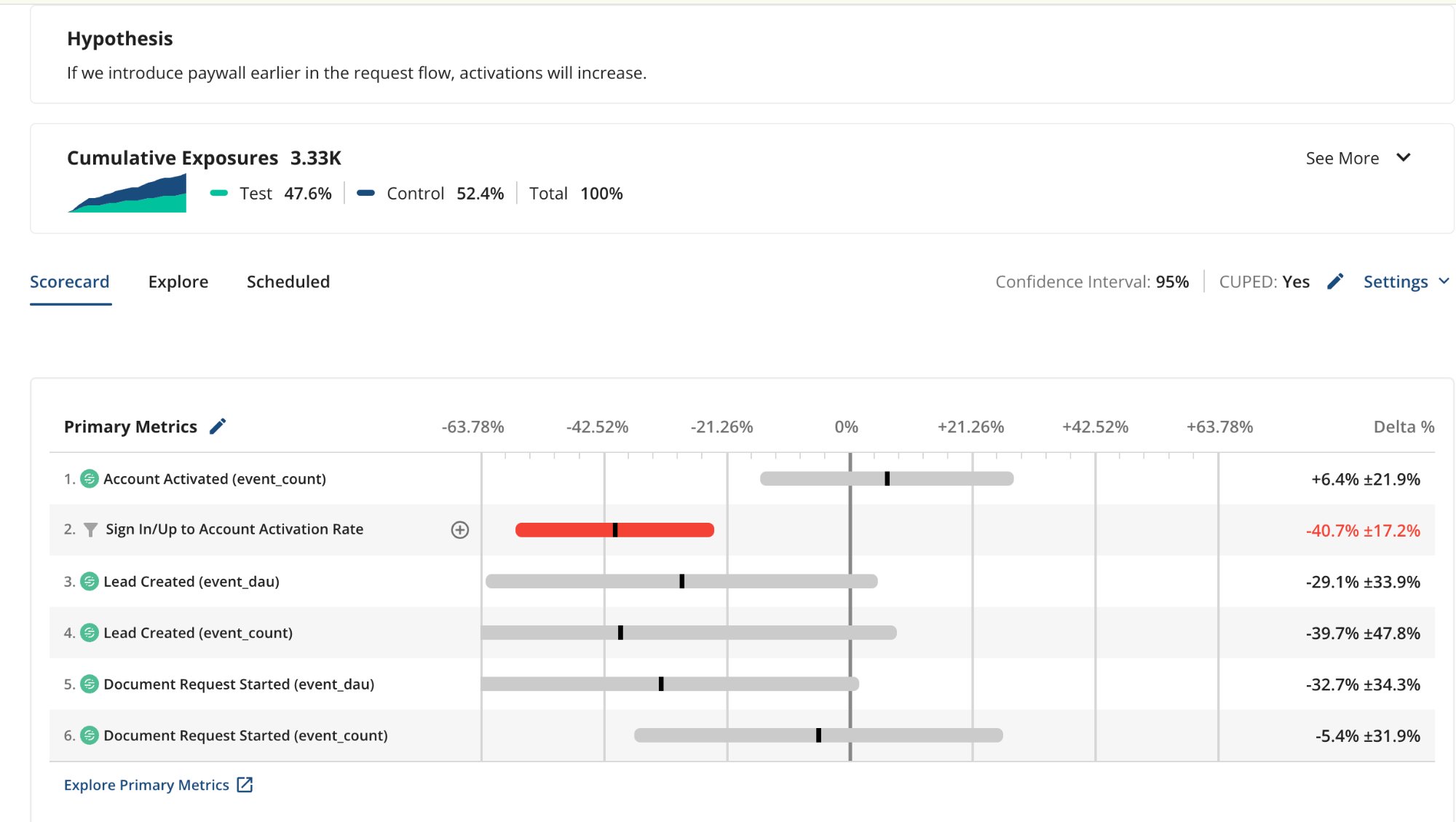
Variation 2 (3.33K exposures): -40.7% drop in Sign In/Up to Account Activation Rate — a clear signal that showing paywall too early killed the funnel. This negative result was just as valuable for informing our final approach.
41.1% increase in account activations. Final variation also improved downstream engagement, meaning users who signed up stayed active — not just creating empty accounts.
Regional Availability Filters
A supplier might list a product as available in "LATAM" but exclude Mexico. A buyer in Mexico would find the product, engage with it, request a quote — then discover they can't actually buy it. This mismatch created friction, wasted time, and eroded trust.
The core insight was that this wasn't just a filter problem — it was a data reconciliation problem. Suppliers and buyers had fundamentally different mental models for how regions work.
— From stakeholder interviews across Product, Knowledge, and Customer SuccessThe approach:
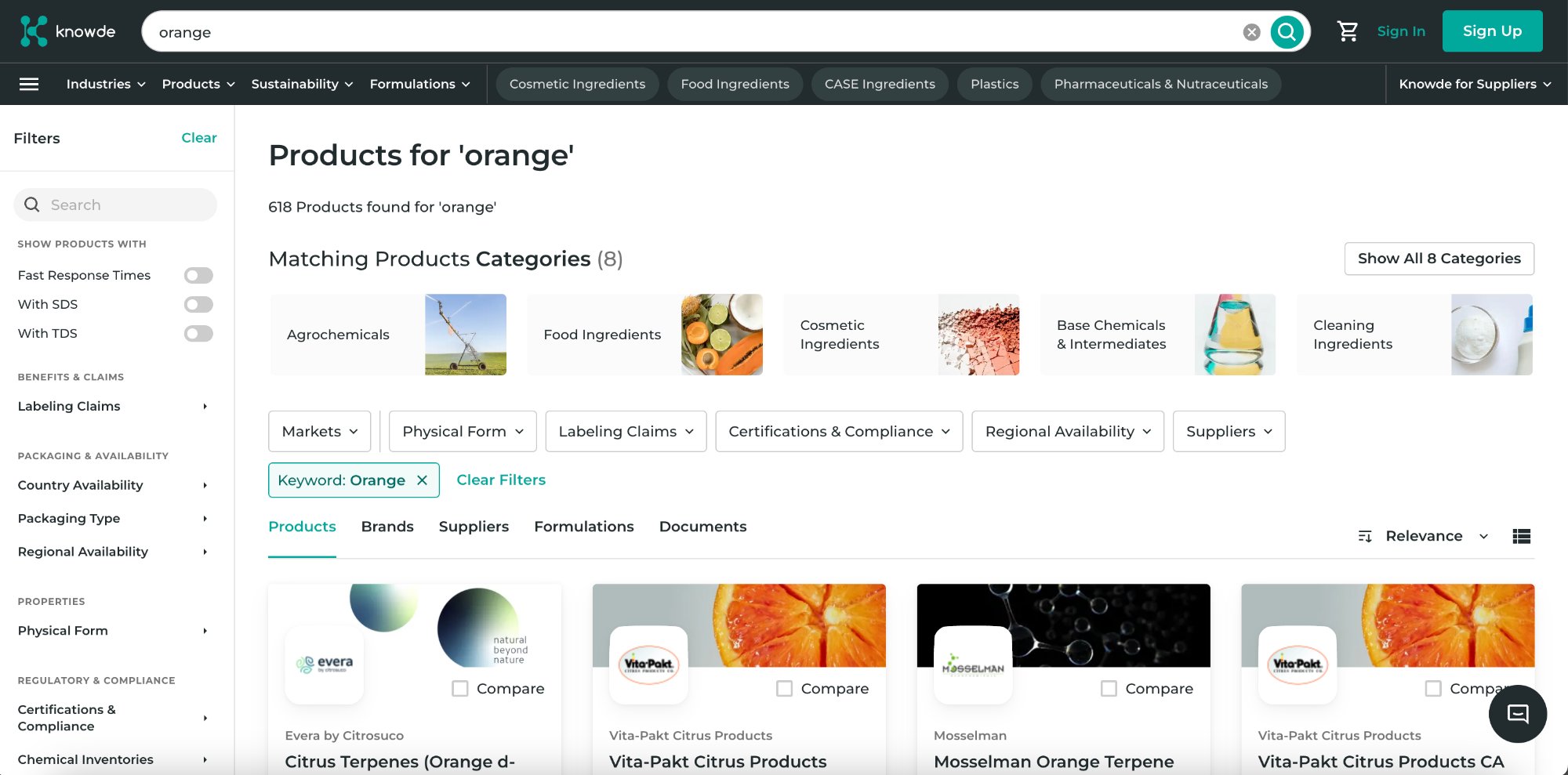
Search results for "orange" — 618 products across 8 categories. Filters on the left (labeling claims, country availability, packaging type) help buyers narrow results.
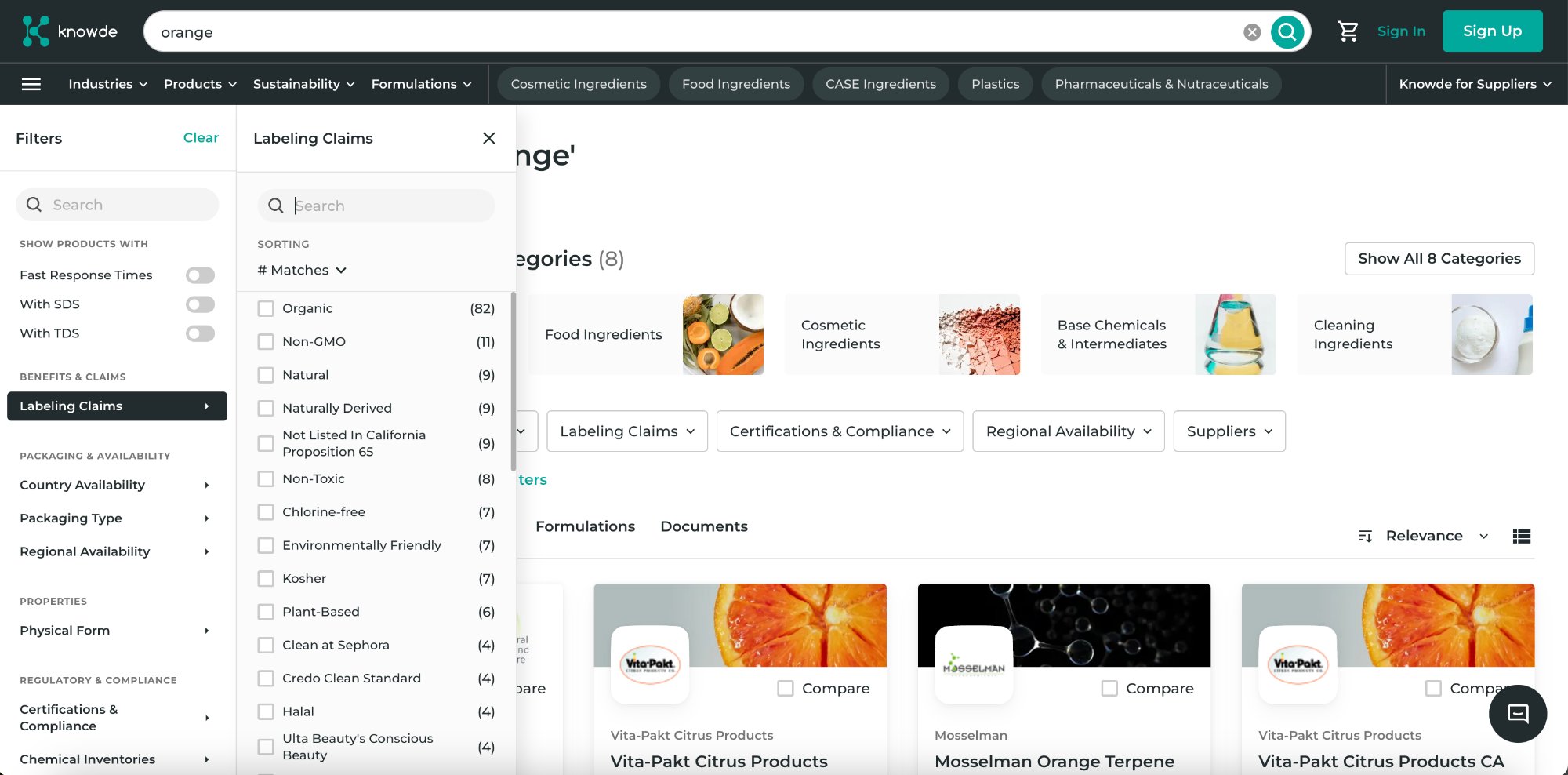
Expanded labeling claims filter — Organic (82), Non-GMO (11), Natural (9), etc. These facets helped buyers find compliant products without manually checking each listing.
Cleaner UX that prevented irrelevant results, reduced buyer drop-off, and improved qualified lead generation. At tradeshows, the unified region-first filtering flow became a key demo moment.
Compatible & Similar Products Recommendations
When a buyer found a product, they had no way to discover related SKUs — products that pair well together (compatible) or serve as alternatives (similar). In an industry as complex as chemicals, this meant buyers were doing manual research outside the platform.
The approach:
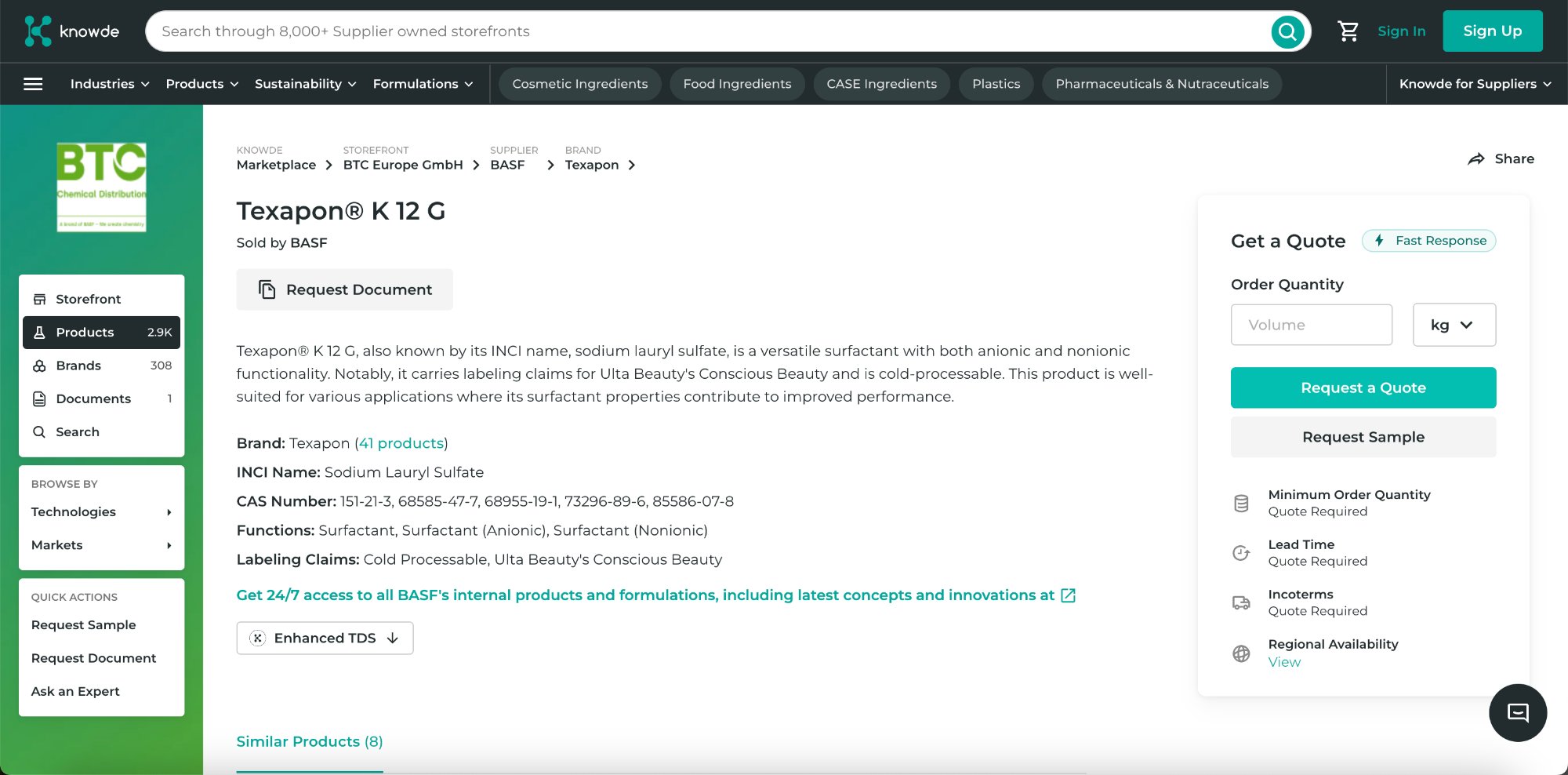
A product detail page (Texapon® K 12 G by BASF) — showing INCI name, CAS numbers, functions, labeling claims, and the "Request a Quote" flow. Similar Products (8) are surfaced below, and the supplier storefront provides full catalog access.
Launched recommendation engine that surfaced scientifically accurate product pairings. Think of it like Amazon's "Frequently bought together" — but for industrial chemicals, where getting the pairing wrong has real consequences.
Smart Search Bar & Personalized Appbar Pills
The chemical industry has thousands of niche applications and ingredients. Buyers often don't know the exact product name — they know the end use ("lip gloss," "epoxy coating") or the function ("solvent-free," "UV resistant"). The search experience needed to bridge that gap.
The approach:
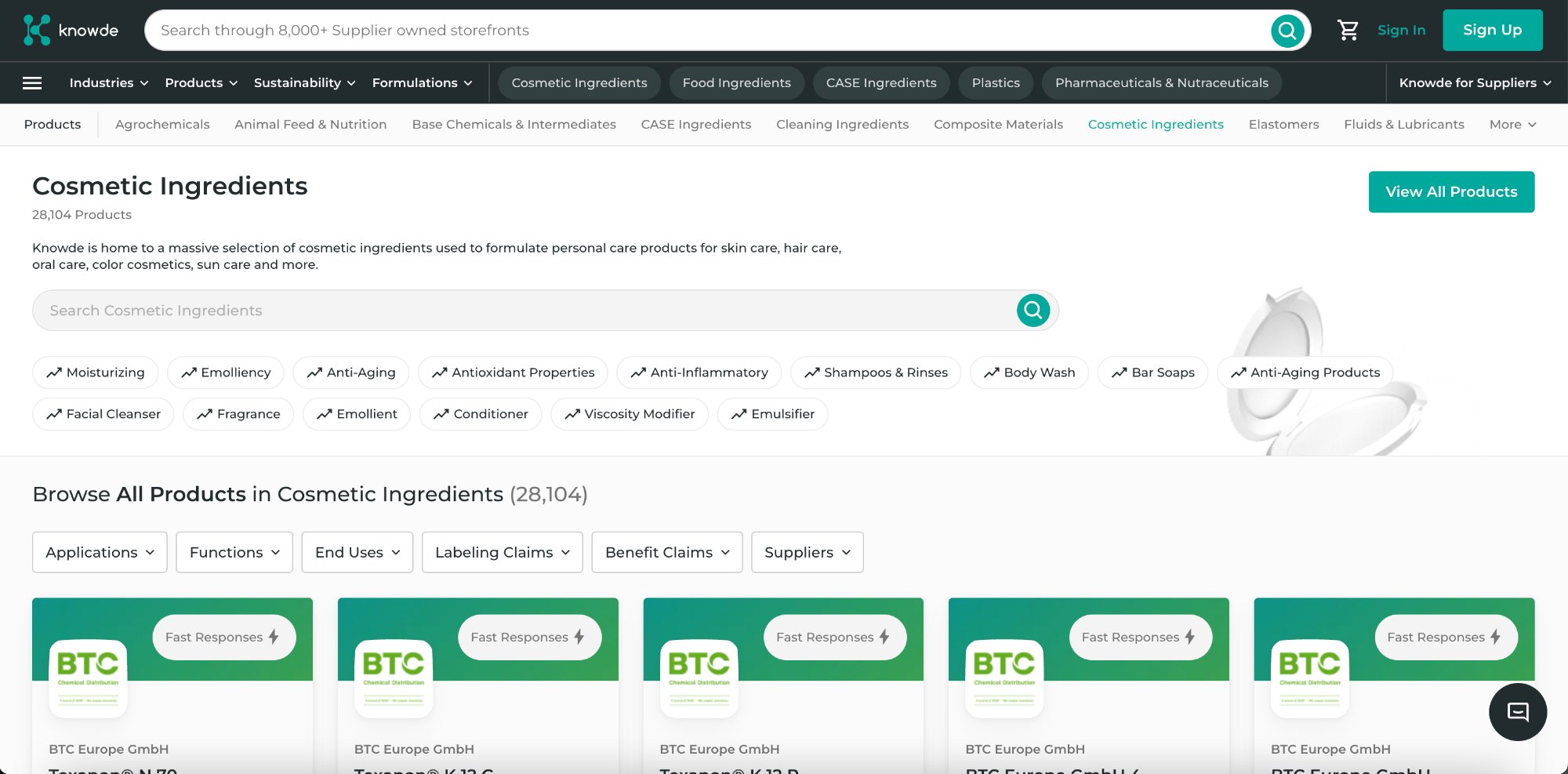
Cosmetic Ingredients category page (28,104 products) — dynamic search pills ("Moisturizing," "Anti-Aging," "Emollient," etc.) adjust based on the category context, bridging buyer language with supplier data.
Personalized the discovery experience while keeping it intuitive. Helped bridge the gap between buyer language and supplier data — a critical friction point in B2B chemical commerce.
Demoing at industry tradeshows — "Imagine a 24/7 tradeshow"
I participated in tradeshow demos where we pitched Knowde directly to chemical buyers and suppliers. The pitch framework I helped develop centered on making the platform tangible: "You're at a tradeshow right now, but imagine you could be at a 24/7 tradeshow."
Key demo flow I contributed to:
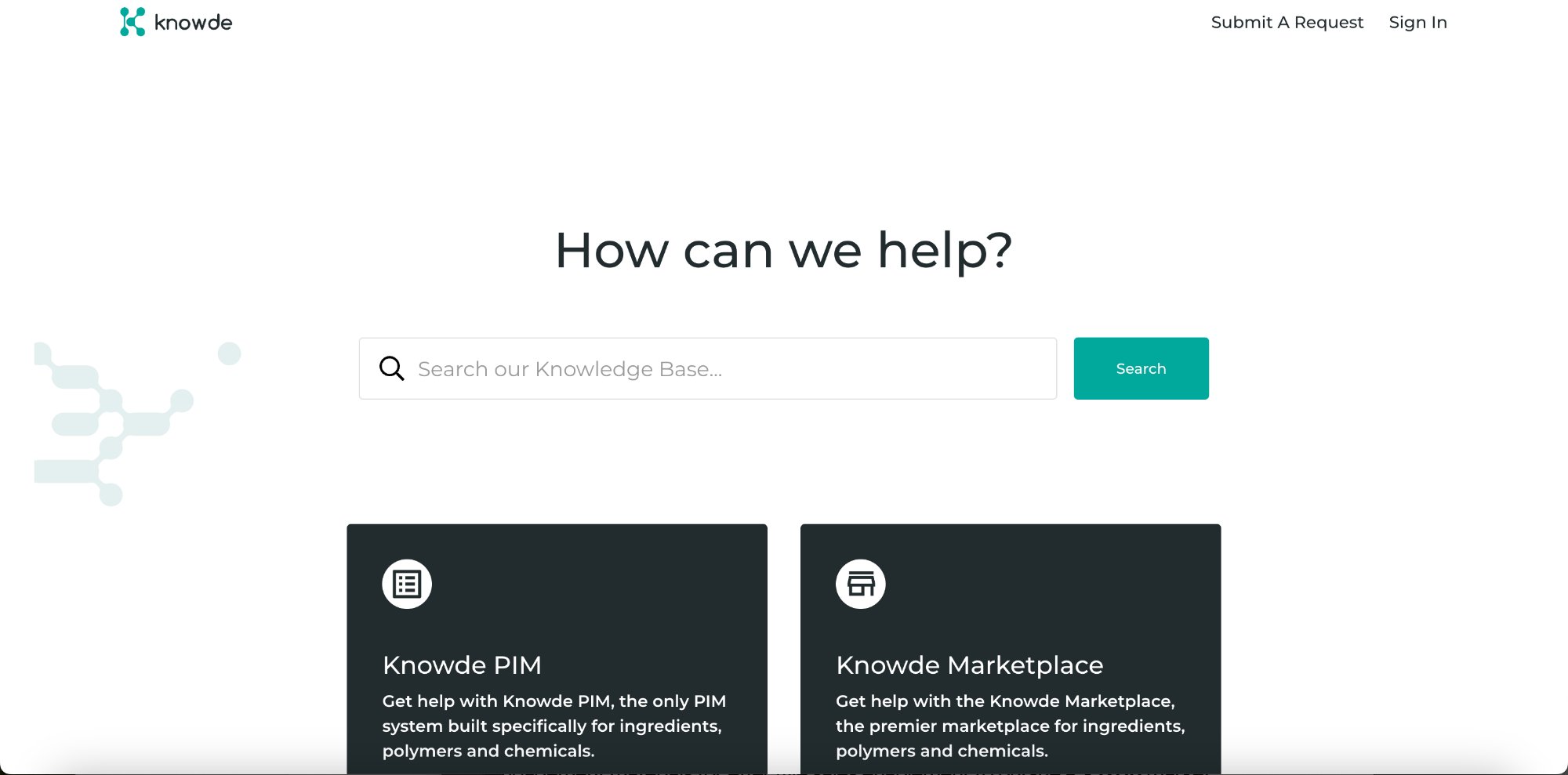
The Knowde help center I led and built — support articles for both PIM (supplier-facing) and Marketplace (buyer-facing) products, which I owned as part of product launch workflows.
What I learned about building for B2B marketplaces
To have sellers, you need buyers — vice versa. But if you prioritize the buyer experience, suppliers will follow because there's an incentive. Buyers are the main source of revenue.
— My framework for the chicken-and-egg marketplace problemRecommendation systems require domain expertise, not just data. Compatible Products couldn't be built by algorithm alone — we needed chemists to define what "compatible" actually means in formulation science. The best PM work here was translating between subject matter experts and engineers.
Personalization in B2B is about closing language gaps. Buyers think in end uses ("lip gloss"). Suppliers think in chemical functions ("emollient blend"). The search and discovery features I built were fundamentally about translating between these mental models.
Iterate quickly with low design resources. With a lean team, I learned to ship features that were good enough to validate, then invest in polish based on data. The A/B tests on paywall placement went through multiple rounds — each round taught us something new about buyer behavior.